
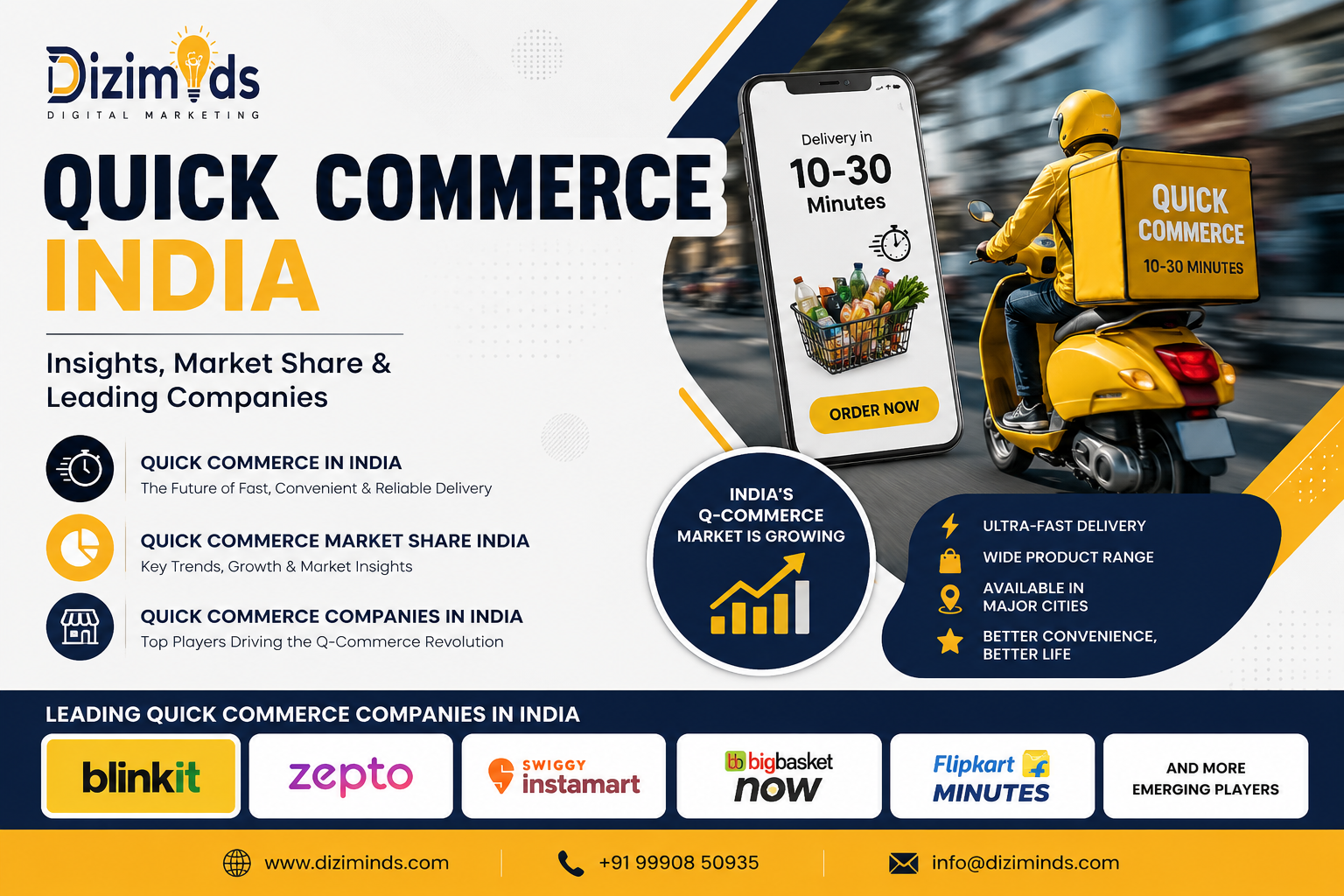
Ten years back, Indian consumers had no choice but to wait for hours or days to get their online essentials delivered at home. That has changed radically with the advent of quick commerce platforms, which promise delivery of essentials in the range of 10–30 minutes. The expectations of Indian consumers with regard to convenience and modern online shopping have evolved. Now, they can expect everything from groceries to household and personal care products and snacks to be delivered at their doorsteps within a few minutes.
Quick commerce has been able to grow and expand in India, thanks to the rapid adoption of smartphones, digital payments, and the urban lifestyle. Quick commerce is one of the fastest growing segments in the e-commerce market in India and one of the most funded.
What is Quick Commerce?
Quick commerce, or Q-commerce for short, is an advanced version of e-commerce that focuses on the super fast delivery of an ordered product. Quick commerce differs from traditional online shopping in that the delivery of ordered products is done in a matter of minutes, thanks to the use of dark stores and fulfillment centers located strategically.
The focus of quick commerce is to offer customers super fast access to the products that they need and to provide an easy shopping experience at the same time.
Growth of Quick Commerce in India
The growth of quick commerce is a recent phenomenon in India. The convenience of avoiding the time consuming and sometimes inconvenient trips to a physical store has been compelling to urban dwellers, working professionals, and young families.
The rapid expansion of the quick commerce sector can be attributed to:
The growth of smartphone adoption
Enhanced digital payment options
Increased internet access
Emerging shopping habits
Dark store networks
Because of these, quick commerce businesses have expanded to offer a variety of products and services, from groceries to electronics and even healthcare, in more cities.
India's Quick Commerce Market
The India quick commerce market is becoming more competitive due to significant investments by the major players in building and maintaining delivery infrastructure and widening the customer base. The market is characterized by a small number of major players who dominate the industry due to the extensive delivery networks and large customer bases they have built.
The quick commerce sector has experienced significant growth in large part due to the rapid increase in the volume of customer orders and an increase in the number of repeat customers.
Market share growth is attributed to the sector's focus on:
Optimizing delivery speed
Expanding and optimizing inventory systems
Enhancing customers' shopping experiences
Competition in the sector is good for the customer, as it means:
Shorter delivery times
Lower prices
Better deals and more options
More efficient logistics
Better customer service
It will drive the advancement and growth of the quick commerce sector in India.
India's Top Quick Commerce Players
Leading the transformation of commerce through the delivery of products in real-time are the quickly evolving quick commerce players in India.
Blinkit
Blinkit is quickly becoming one of the top players in the Indian quick commerce industry. They provide dark store grocery delivery through a network of dark stores throughout the urban centers of India.
Zepto
Zepto has made a name for itself by delivering goods at incredible speeds. Its target market focuses on delivering daily essentials, groceries, and everything in-between in a matter of minutes to city dwellers.
Swiggy Instamart
Thanks to integrated logistics, Swiggy Instamart provides a delivery network that is as extensive as its product offering, which includes groceries, snacks, personal care, and household products.
BigBasket Now
BigBasket does what it does best by combining its grocery knowledge with the ability to fulfill fast delivery demands and expanding its business to the quick commerce sector.
Flipkart Minutes
Flipkart Minutes is a new name in quick commerce. Its service looks to fill the market need for delivering groceries, staples, and other daily items in record time.
Benefits of Quick Commerce in India
Truly, there are a host of benefits that quick commerce has brought to the Indian consumer as well as the Indian business.
Convenience
Consumers can place orders whenever they want and have goods delivered to them without leaving home or visiting a store.
Time Savings
Fast delivery saves consumers the most precious resource of all; time, especially when it is in limited supply.
Better Customer Experience
Quick commerce strives to implement the best ordering systems with delivery that has real-time tracking and is done on time.
Increased Business Opportunities
Quick commerce allows sellers to easily reach consumers, and therefore increases sales and business presence.
Enhanced Product Availability
The variety of products available has increased each time a new quick commerce app has been launched.
Challenges
Quick commerce has a lot of growing to do, especially in India, with some of the obstacles it has already faced.
High Operational Costs
To run the dark stores, the delivery fleets, and the inventory management systems, a lot of initial capital is required.
Profitability Concerns
Usually, companies prefer to prioritize growth and increase market share rather than considering profitability in the short-term.
Intense Competition
Competition is continuing to grow among Indian quick commerce companies, and is beginning to affect prices and profit margins.
Supply Chain Management
It can be challenging to manage the operational complexities of fast fulfillment and having the right amount of inventory.
Future of Quick Commerce India
The immediate future of quick commerce in India looks incredibly bright. With the effects of urbanization and an ever-evolving consumer, the quicker the delivery, the greater the demand. This is most certainly the direction in which the industry is headed.
According to the experts, the industry will continue to grow into tier-2 and tier-3 cities, broaden its selection of products, and improve its technology. AI, predictive analytics, and better systems of inventory automation will improve the industry.
Companies that have the best logistics infrastructure and the best customer experience will lead the industry.
Conclusion
Quick commerce is the most advanced sector of e-commerce aggregation, enabling on-demand shopping. Industry growth has been spurred by convenience, technology, and investment. As the quick commerce market expands, leading companies in the sector are transforming Indian retail and raising the bar for customer satisfaction. With the high growth potential and changes in consumer behavior, quick commerce will continue to be a focal point of India's digital commerce for years to come.
READ MORE BLOG - Why Meesho Customer Reviews Matter for Buyers